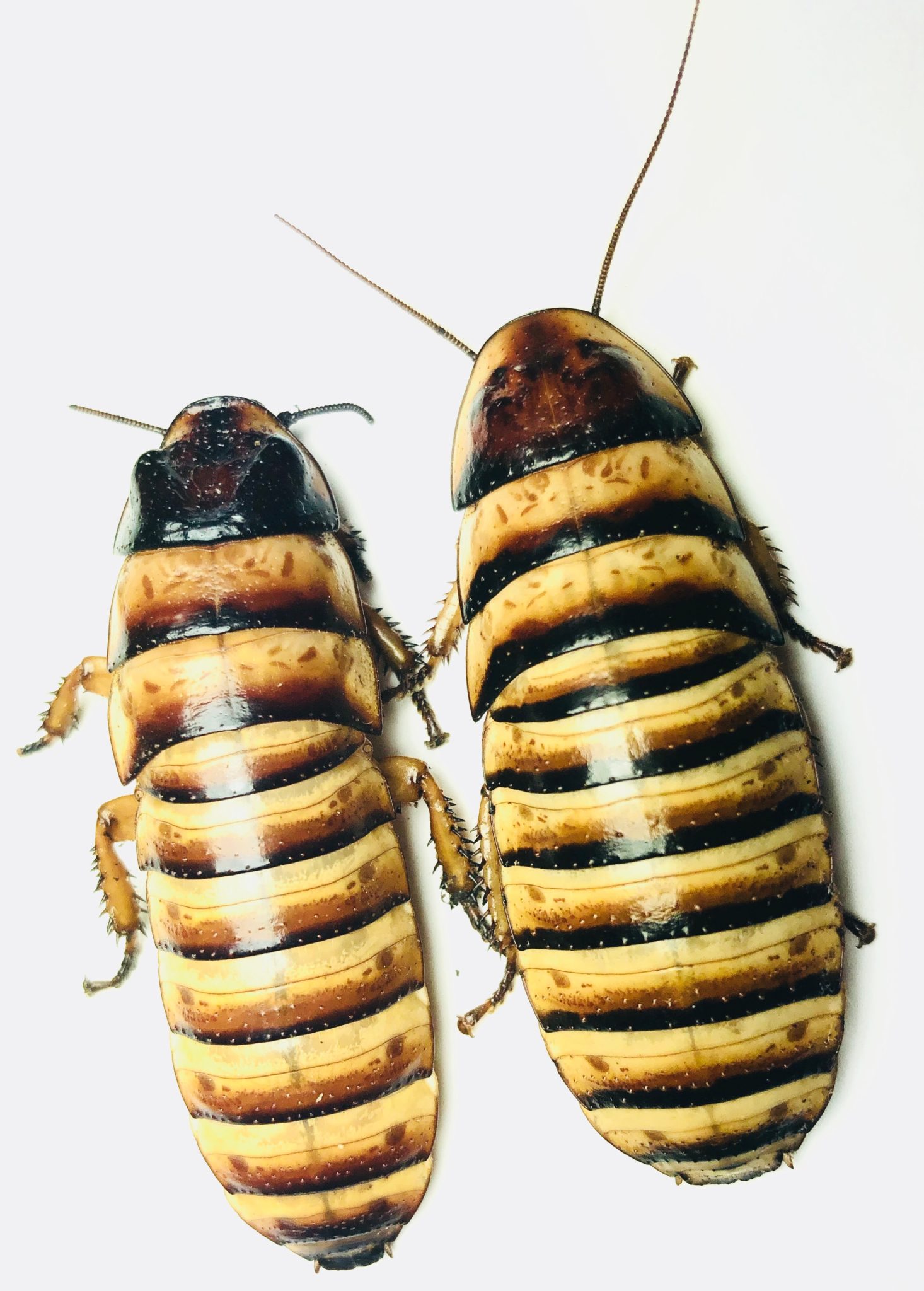

Halloween Hisser (Elliptorhina javanica)
Halloween Hisser Care Guide: Breeding & Husbandry
The Halloween Hisser is widely considered one of the most striking and “handsome” species within the Madagascar hissing cockroach group. Known for their bold, high-contrast markings and manageable size, they are a favorite among entomology enthusiasts and exotic pet keepers alike.
Halloween Hisser Species Description
Halloween Hissers are distinguished by their deep ebony-brown bodies contrasted by vivid cream-colored stripes along the abdomen.
-
Size: They typically reach 1.5 to 2 inches in length, making them a medium-sized species compared to the Common Hisser.
-
Color Morphs: There are two primary color forms observed in the hobby—one featuring a red pronotum (the shield-like structure behind the head) and the other a solid black pronotum.
-
Maturation: Nymphs are born almost entirely black, gradually developing their signature “Halloween” color scheme through successive molts until they reach maturity.
Origin and Natural History
The original collection data for the Halloween Hisser is historically associated with the Toliara (Tuléar) Province in southwestern Madagascar.
Specifically, many lineages in the hobby are believed to have originated from the Anakao region. Because this area is characterized by spiny forests and a more arid climate than the eastern rainforests, it explains why this species is slightly more sensitive to extreme moisture and prefers the specific “warm and humid” balance found in their native microclimates.
Why the location is “Vague” in the Hobby
As you noted in your original text, collection data in the insect hobby can be shrouded in secrecy for a few reasons:
-
Political Instability: Madagascar has faced frequent shifts in government and environmental policy, making legal export permits difficult to obtain and track.
-
Protection of Locality: Collectors often keep specific GPS coordinates secret to prevent “over-collecting” in a single area, which could crash a local wild population.
-
Taxonomic Confusion: For years, Halloween Hissers were traded under several different names (and even different genera like Gromphadorhina and Elliptorhina). Without a “Type Specimen” tied to a specific tree or coordinate, the exact forest of origin is often lost to time as the roaches are passed from breeder to breeder.
Scientific Note on the “Halloween Hisser” Name
While “Halloween Hisser” is the common name, in scientific circles and high-end rearing, they are most often identified as Elliptorhina javanica. Despite the name javanica, they are not from Java; they are strictly endemic to Madagascar.
Reproduction and Life Cycle
Halloween Hissers exhibit fascinating social and reproductive behaviors.
-
Mating Rituals: Males utilize the “horns” (bumpy protrusions) on their pronotum to joust for territory and mating rights.
-
Live Birth (Ovoviviparity): Females produce a long, yellow egg case called an ootheca. Instead of laying it, they retain it inside the abdomen for approximately 60 days.
-
Halloween Hisser Brood Size: A single ootheca can yield between 12-30 nymphs.
-
Neonate Care: Newly emerged nymphs are pure white and remain close to the mother to feed on initial secretions that provide essential nutrients.
- Environmental Triggers: Reproduction is highly temperature-dependent; successful breeding typically requires consistent temperatures above 80°F. If conditions are too crowded or nutrition is poor, females may “abort” the ootheca.
Development and Growth
Nymphs undergo 6 to 7 molts over a period of 6 to 10 months.
-
Humidity is Key: Proper humidity levels are essential during the molting process to prevent “stuck sheds,” which can be fatal.
- Recycling Nutrients: It is natural behavior for nymphs to consume their shed exoskeleton to reclaim lost calcium and nutrients.
Nutritional Requirements
While hissing roaches are generalist scavengers, a high-quality diet leads to faster growth and more successful breeding.
-
Fresh Produce: Offer organic oranges, Apples, bananas, and zucchini. Tip: Use organic options whenever possible and avoid foods high in phytates or oxalates, which can interfere with calcium absorption.
-
Protein: High-protein intake is crucial for gravid females. Place dry dog food on the side of the enclosure that is dry to help with keeping it from molding.
Housing and Colony Management
Halloween Hissers thrive when they feel secure and slightly crowded.
-
Substrate: Use a mixture of peat moss or coco coir. Keep the medium slightly damp on one end of the enclosure. Also adding a pad of long fiber sphagnum moss gives them a moist area to go to if they need additional water or humidity.
-
Hardscape: While many keepers use egg cartons, we recommend natural tree bark stacked flat on top of other pieces. This mimics their natural forest floor habitat and helps maintain localized humidity pockets.
-
Thermal Gradient: Place a heat mat under one side of the enclosure. Misting the substrate on the non heated area will encourage natural evaporation, maintaining the humidity these roaches require. Proper ventilation is also critical they want some airflow so one or two vents installed in the lid and on the headed side of the container is good.
Halloween Hisser Rearing Notes for Success
Halloween Hissers reproduce slightly slower than the Common Hisser (G. portentosa), but they are highly productive once established. The secret to a thriving colony is consistency: regular high-protein feedings, fresh ripened fruit, and stable tropical temperatures.
For more information on this species click the link below
http://www.roachcrossing.com/for-sale/roach/all/halloween-hisser/